GroovyMorning_RLAC
Introduction to GroovyMorning: Real-Time Radio Stream Personalization
This series of articles documents the technical challenges and architectural solutions implemented to ensure the automated capture, analysis, and distribution of radio segments.
The Pillars of the System
To go from a raw audio signal to a functional mobile application, GroovyMorning relies on the following five pillars:
- Capture (RLAC-AudioRecorder): A high-availability Java module ensuring continuous recording and HLS segmentation.
- Intelligence (IAChronicleDetector): A Python analysis engine using artificial intelligence to identify various radio segments in real-time.
- Synchronization: A temporal correction and fingerprinting mechanism to align distributed streams.
- Data Infrastructure: A dataset creation pipeline for model training and evaluation.
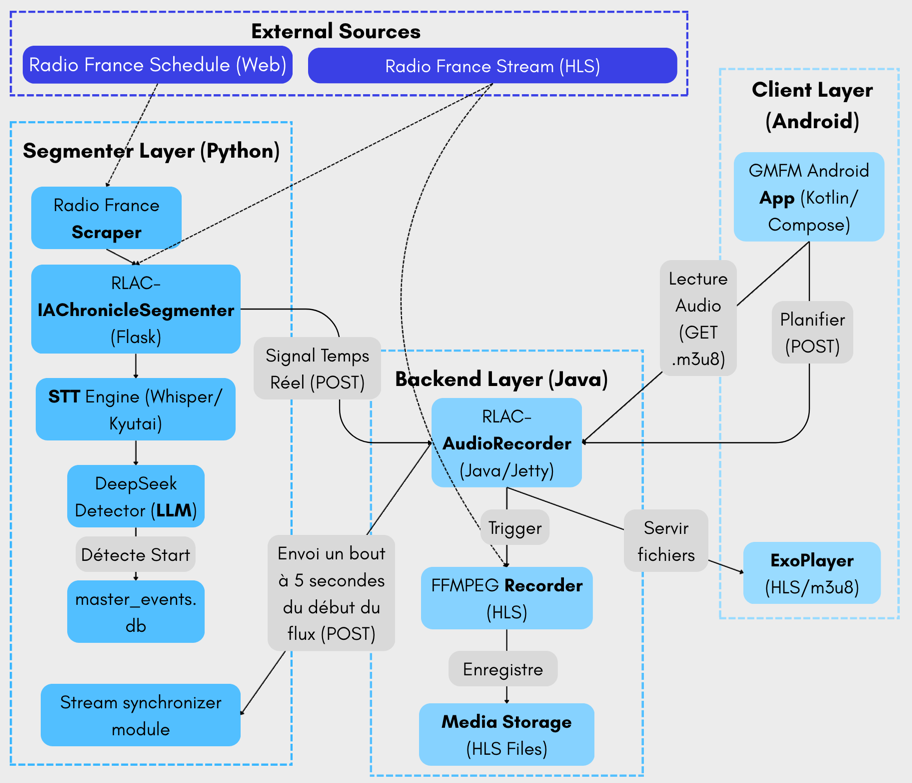
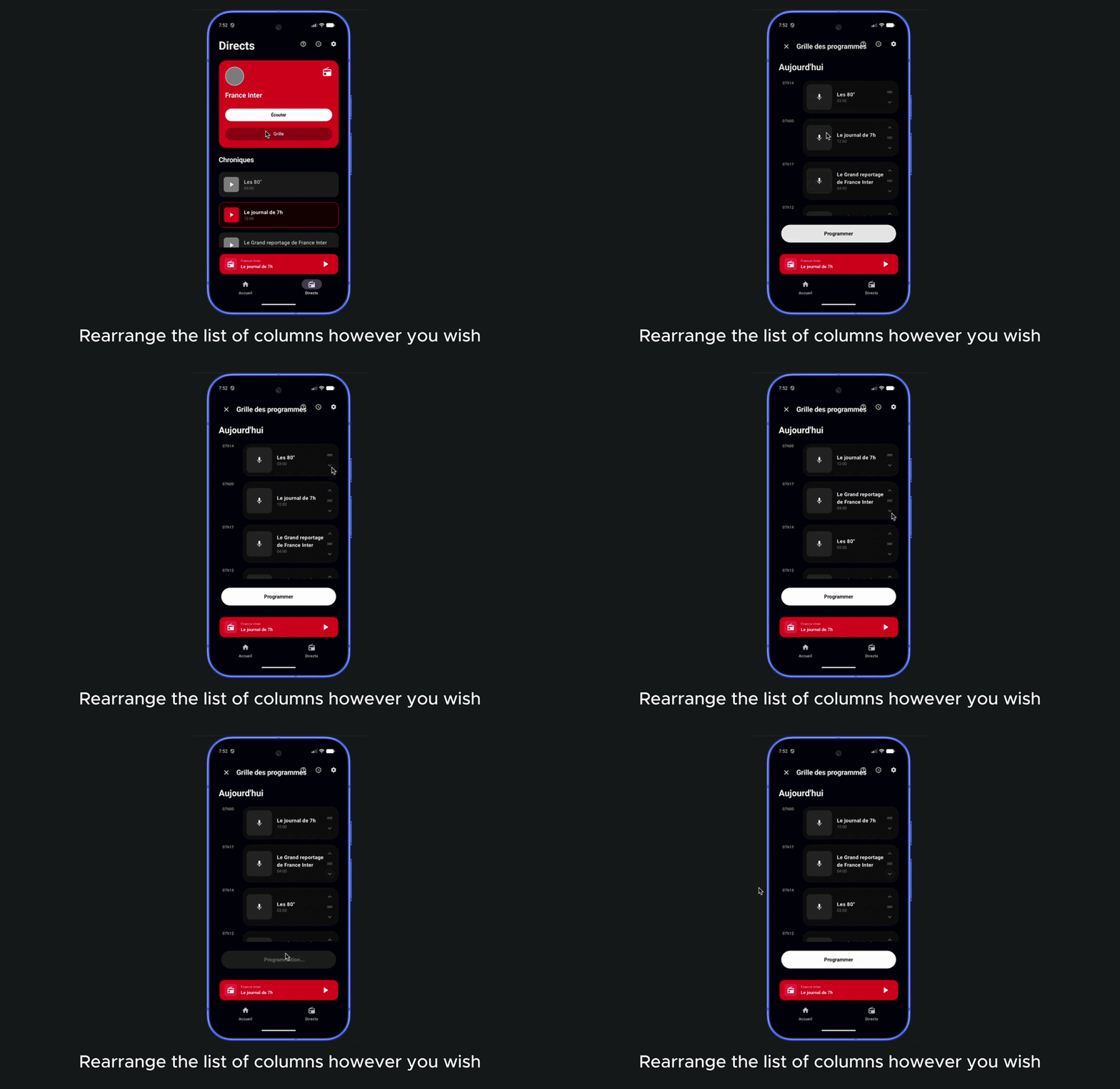
- Mobile Application: A mobile application allowing users to customize the radio grid and listen to it.
Structure of the Technical Series
The series is structured into twelve chapters, each addressing a specific aspect of the processing pipeline.
1. AI-Powered Chronicle Detection
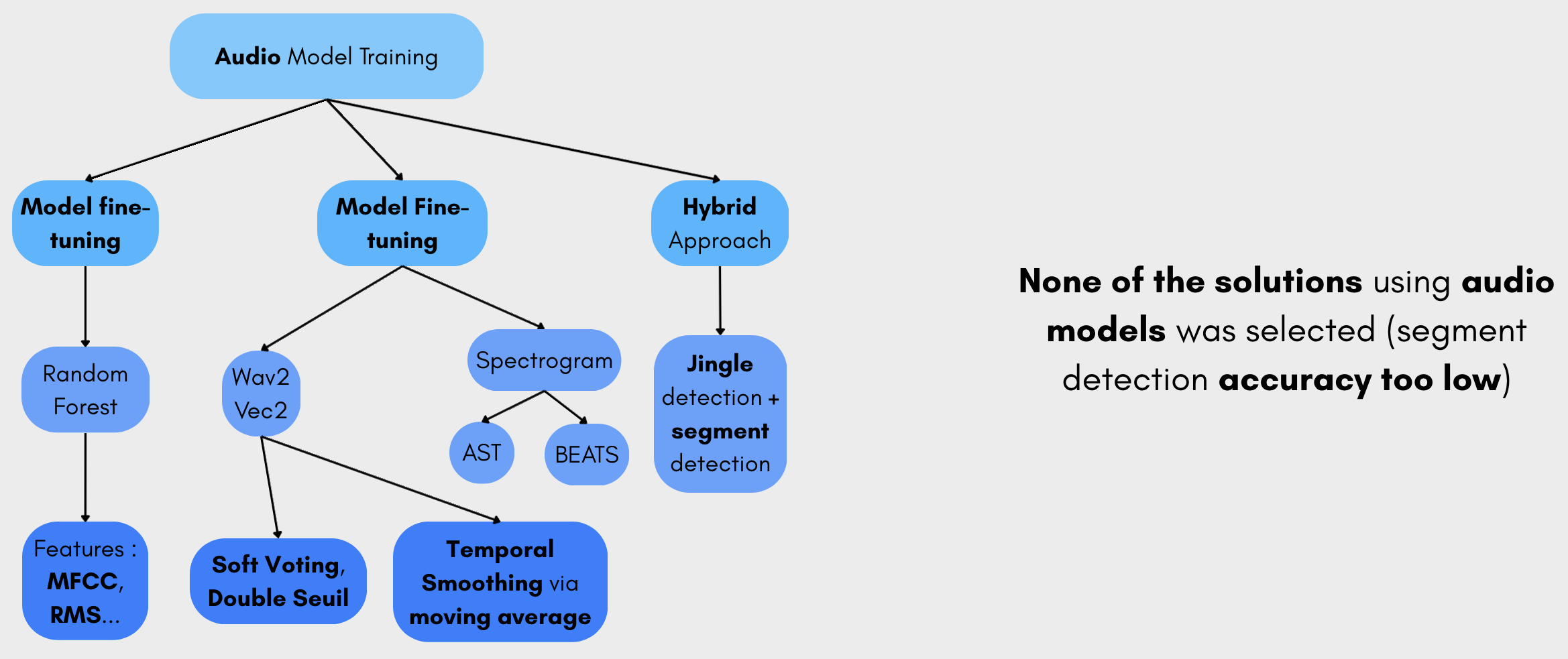
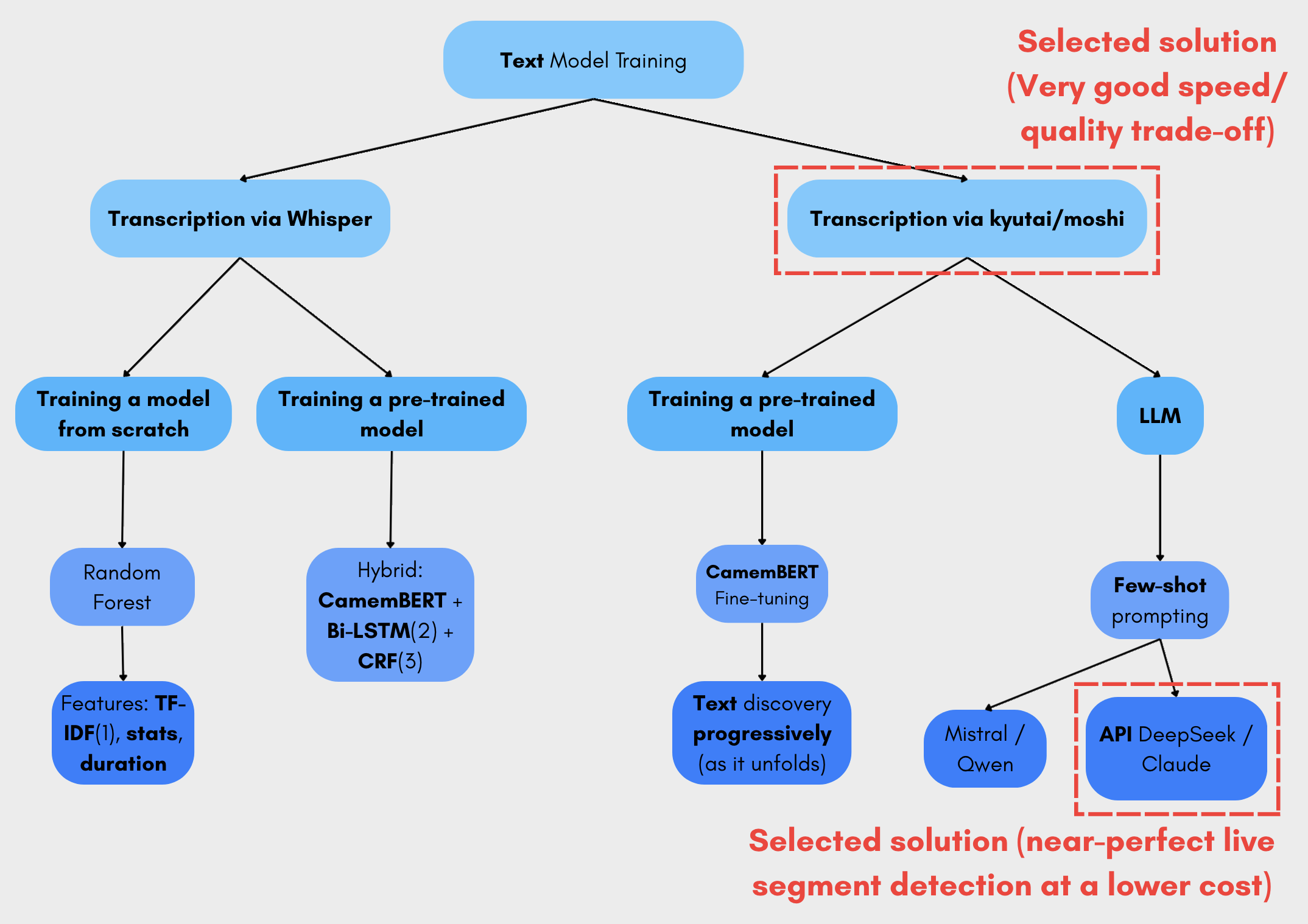
Analysis of different identification methods (LLM, Machine Learning, Spectral Analysis) and the implementation of a JSON interoperability standard for detectors. Access the article
2. Audio Recalibration and Synchronization
Management of latency between the detection server (Python) and the recording server (Java). Use of physical links (hard links) for retroactive correction without disk overhead. Access the article
3. Quality Evaluation Framework
Implementation of a benchmarking system to measure the accuracy of segmentation models and their ability to meet real-time constraints. Access the article
4. Latency Calculation and Master Sync
Use of audio fingerprinting to calculate and compensate for the offset between two distant HTTP streams. Access the article
5. Transcription and Semantic Analysis
Implementation of STT (Speech-To-Text) pipelines with Whisper and Kyutai. Semantic analysis via DeepSeek to extract meaning from radio transitions. Access the article
6. Global Pipeline Architecture
Overview of system orchestration. Logical diagram of data flow between capture, the AI engine, and the distribution API. Access the article
7. High-Availability Audio Capture
Focus on the Java/Spring Boot module. Management of FFmpeg, capture threads, and the “Master Stream” concept to allow dynamic rewinding. Access the article
8. End-to-End Test Validation
Simulation of a live radio stream via Docker and Unix pipes to validate the complete processing chain without depending on real broadcasting. Access the article
9. Dataset Creation and Ground Truth
Methodology for mathematical alignment between official podcasts and the live stream to automatically generate labeled training data. Access the article
10. Model Hub and Datasets
Using Hugging Face to centralize, version, and distribute the project’s AI models and datasets. Access the article
11. Monitoring with WandB
Tracking training experiments and visualizing performance metrics in real-time via Weights & Biases. Access the article
12. AI Models Finetuning
Exploration of architectures (CamemBERT, AST, Wav2Vec2) and post-processing techniques to refine detection accuracy. Access the article