GroovyMorning_RLAC
Global Architecture: From Radio Signal to Mobile Application
The GroovyMorning (GMFM) project was born from a simple need: to never miss favorite radio chronicles and be able to listen to them on demand, without ads, with an experience close to a podcast, but for live content.
To transform a continuous radio stream into a library of segmented and indexed chronicles, a robust and distributed architecture was implemented.
Pipeline Overview
The system relies on four main pillars working in harmony:
- Capture (Java): A “Master” service that listens to the radio 24/7, creates a continuous buffer, and manages audio file writing to disk.
- Intelligence (Python): An analysis engine that “listens” to the stream in parallel to detect jingles and transcribe text in real-time.
- Orchestration (Database & API): A central pivot linking AI detections with recording commands.
- Consumption (Mobile): Android and iOS applications that allow scheduling listens and playing files via the HLS protocol.
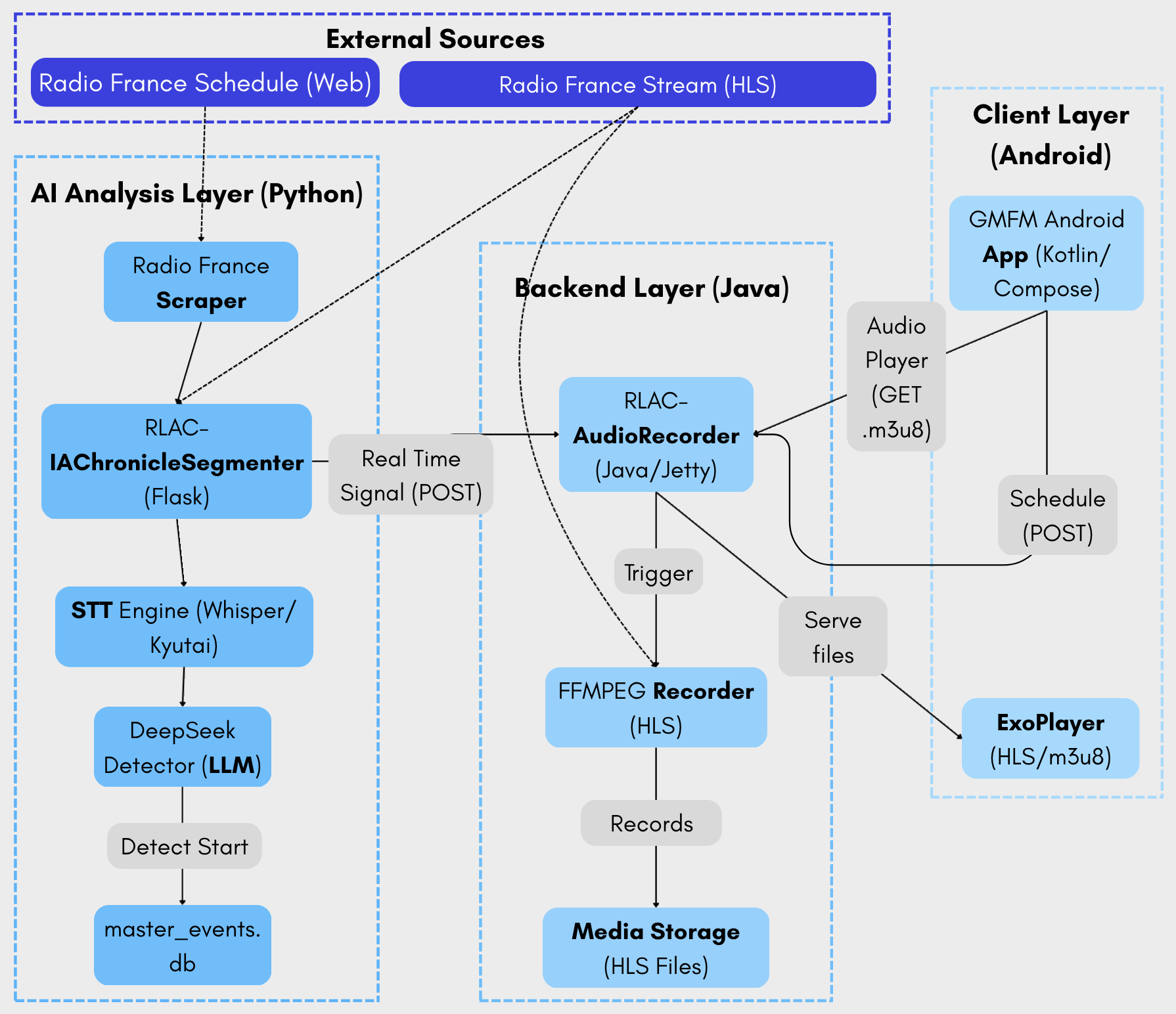
Logical Flow Diagram
graph LR
    Stream((Radio Stream)) --> Java[RLAC-AudioRecorder]
    Java --> Disk[(HLS Storage)]
    Java -- 1s Chunk --> Python[AI Segmenter]
    Python -- Detection / Transcription --> DB[(PostgreSQL)]
    DB -- Metadata --> Java
    Java -- REST API --> Mobile[iOS/Android Apps]
Technological Challenges
1. Temporal Synchronization
The biggest challenge is offset (latency). Between the moment the sound leaves the stream and the moment the AI processes the information, several seconds elapse. The architecture uses a system of relative “Timecodes” so that the final segmenting in the Java buffer is surgical, regardless of the AI’s calculation time.
2. Analysis Scalability
AI analysis (Whisper/Kyutai transcription and DeepSeek LLM analysis) is resource-intensive. By separating the capture service (lightweight, in Java) from the analysis service (heavyweight, in Python), the AI can be moved to a GPU-equipped machine without interrupting recording.
3. Mobile Robustness
Thanks to the HLS (HTTP Live Streaming) format, a smooth experience is offered even on unstable mobile connections. The user can start listening to a chronicle even while it is still being recorded (“chase-play” playback).
Conclusion
This modular architecture allows GroovyMorning to be both reliable for capture and extremely flexible for evolving AI models. Each block can evolve independently, ensuring the project’s long-term viability.