GroovyMorning_RLAC
Latency Calculation and Master-Slave Synchronization
In a distributed system like GroovyMorning, where audio captured by a Java recorder is analyzed by a Python segmenter, synchronization is a constant challenge. The Master Sync mechanism was designed to ensure exact correspondence between the Java stream and the Python segmenter.
The Problem: Stream Drift
Several factors introduce an offset (latency) between two servers listening to the same radio stream URL:
- Variations in HTTP caching delays.
- The precise moment each
ffmpegprocess starts. - The impact of CPU load on buffer reading speed.
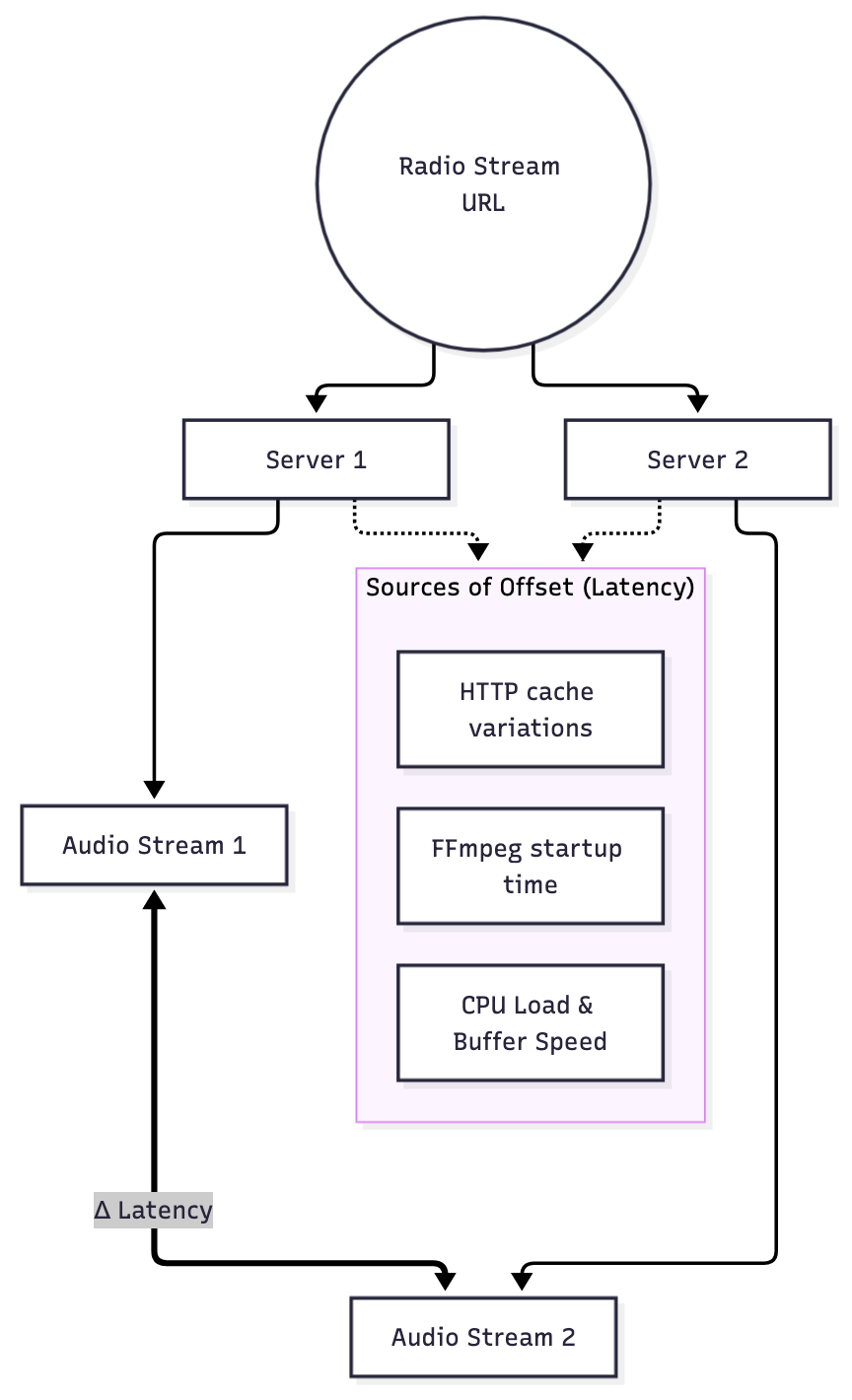 Without recalibration, an offset of several seconds could affect the final recording during AI detection.
The Solution: On-the-fly Audio Fingerprinting
A simplified acoustic fingerprinting technique is used to calculate the actual offset between the two instances. The technical process unfolds as follows:
1. Fingerprint Generation (Java Side)
The Java recorder waits for the first segments of the continuous recording to be written to disk. As soon as segment No. 5 is available (about 5 seconds after startup), a fingerprint is extracted:
- Extraction: Conversion of segments into raw audio (16-bit PCM) via FFmpeg.
- Downsampling: Reduction of audio to 4000 Hz in mono to limit data size.
- Result: A compact binary file (fingerprint.raw) representing 2 seconds of sound.
2. Synchronization Request (/api/sync_offset)
This binary is transmitted via a POST request to the Python segmenter, accompanied by the information positionInSeconds=5. This informs the Python segmenter about the audio state on the Java side at time T=5s.
3. Delta Calculation (Python Side)
A rolling buffer of the audio currently being processed is maintained by the Python segmenter. Upon receiving the fingerprint:
- A comparison is made between the received fingerprint and the buffer data.
- The point of maximum correlation (Cross-Correlation) is searched to identify the exact offset.
- The Delta: A confidence score and a delta are returned. A delta of
3.45indicates, for example, that the Java stream is lagging 3.45 seconds behind the Python stream.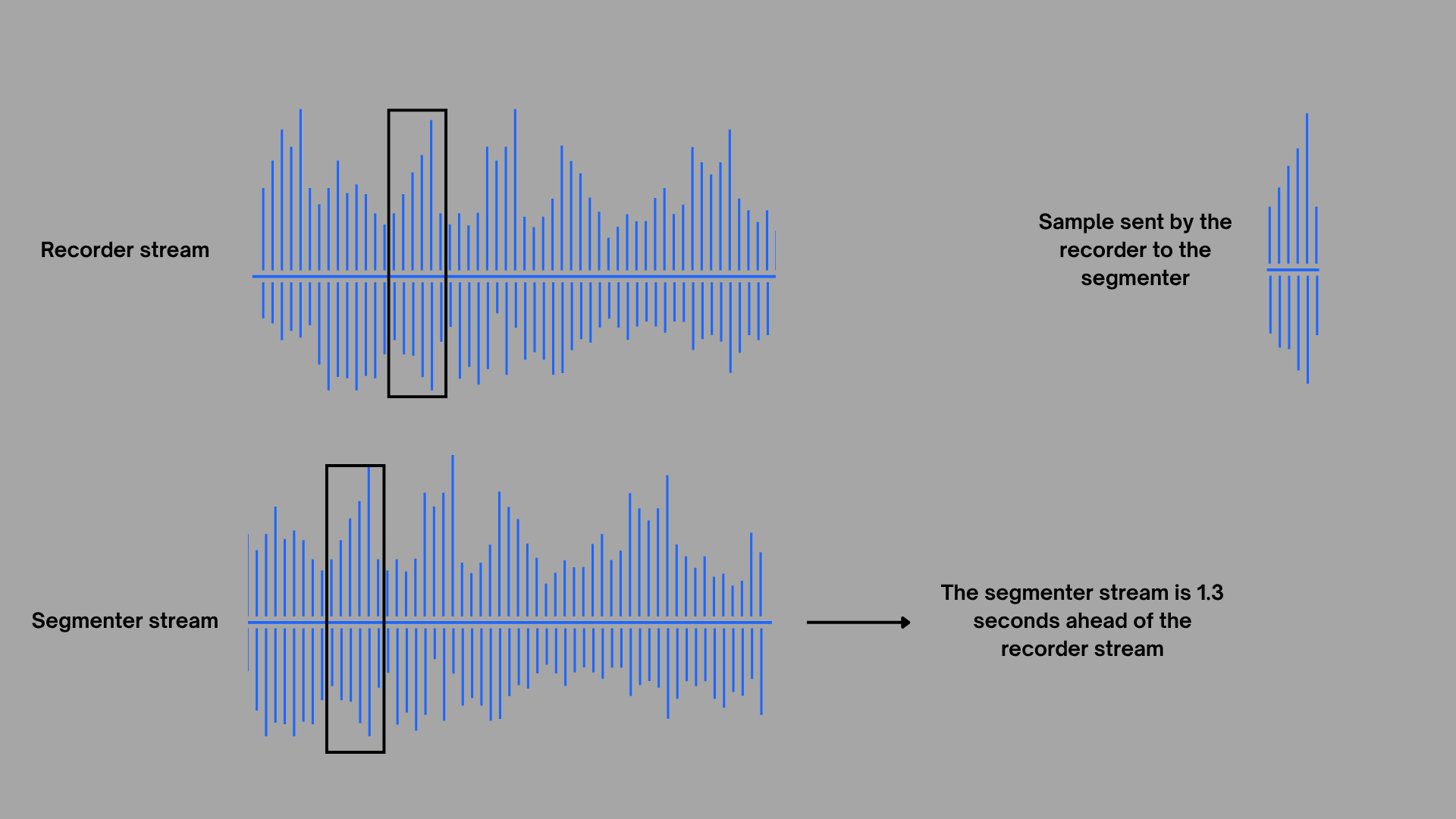
4. Applying Recalibration
The delta received by the Java recorder is stored in the masterOffsetSeconds variable.
- Start Correction: Upon a “START” notification, Java adjusts the recording start time by incorporating this delta.
- Precision: Synchronization is only validated in case of a high confidence score (> 0.7), avoiding any erroneous synchronization on noise or silence.
Why Not Limit to System Time?
While system time (NTP) synchronizes clocks, it does not guarantee the synchronization of stream content. A radio stream can have a variable delay due to broadcasting servers (CDNs). Fingerprinting proves to be the only reliable method to ensure segmentation based on the sound content actually perceived on both sides.
This “Master Sync” mechanism allows GroovyMorning to achieve high precision in chronicle extraction.