GroovyMorning_RLAC
The Journey of Training Audio Models for Chronicle Detection
This article traces the technical evolution and the steps followed to train models capable of automatically detecting radio chronicles within a full broadcast.
Chronicle Detection from Radio Broadcast Audio
Audio Machine Learning
This approach involves using Machine Learning techniques by segmenting long audio files, extracting acoustic features, and training a classifier to identify areas of interest.
In this new approach, we train a model with:
- files containing no chronicles
- files containing only chronicles.
Technical Approach
The default model used is a Random Forest.
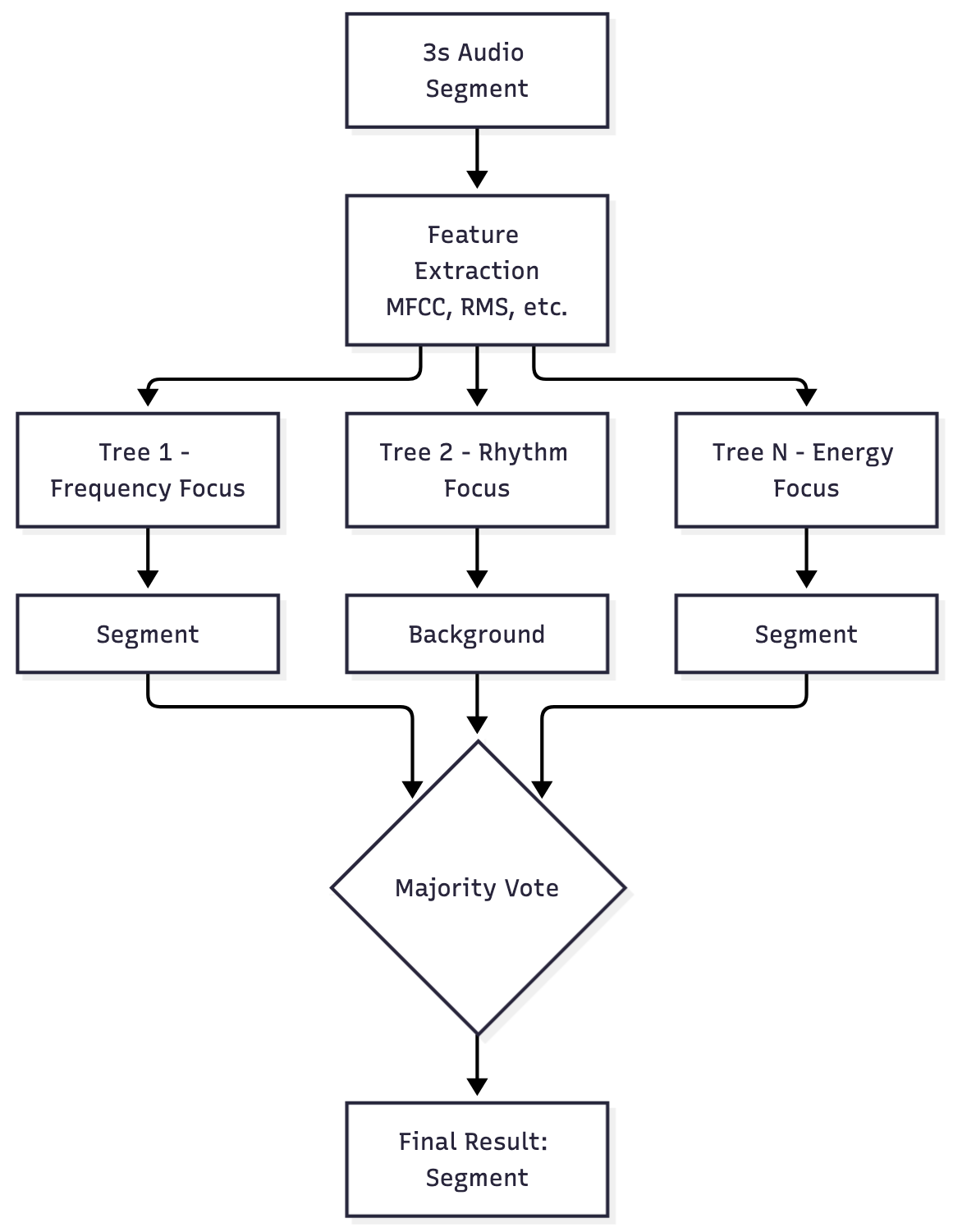
Instead of entrusting the decision to a single algorithm, the Random Forest creates a hundred Decision Trees (hence the name “Forest”).
- Each tree examines the audio features of a segment (MFCC, energy, frequency, etc.).
- Each tree gives its opinion: “It’s a chronicle” or “It’s not a chronicle.”
- The final result is the one that received the most votes (majority wins).
To ensure that the trees are not all identical, randomness is introduced in two ways:
- On the data: Each tree is trained on a different sample of the audio files.
- On the criteria: Each tree only looks at part of the features (for example, one tree might focus on rhythm, another on low frequencies). This prevents the algorithm from becoming “obsessed” with a single misleading detail.
Extracted Audio Features
For each 3-second segment, the system extracts a rich acoustic signature:
- MFCC (Mel-Frequency Cepstral Coefficients): Captures the timbre of the voice.
- Energy per band: Analyzes the frequency distribution.
- Zero-Crossing Rate: Detects the presence of percussion or noise.
- RMS (Root Mean Square): Measures sound intensity.
- Spectral Features: Centroid, Rolloff, and Bandwidth to analyze the “brightness” of the sound (the proportion and importance of high frequencies perceived in a sound).
The model scores 7.69/100 (which is not sufficient), so we switch methods to start from a pre-trained model (to benefit from a model trained on a much larger dataset).
Fine-tuning Wav2Vec2
This approach involves fine-tuning (taking a model already trained on a large volume of data and continuing to train it on a more specific dataset) a wav2vec2-large-xlsr-53-french model for audio segment classification (radio chronicle detection) and performing predictions on new audio files.
Technical Approach
Training
- Chronicle Extraction: Audio files are cut into chronicles according to the provided timecodes.
- Preprocessing: Segments are sampled at 16,000 Hz and normalized.
- Fine-tuning: The
Wav2Vec2ForSequenceClassificationmodel transforms an audio signal into a sequence of numerical vectors that capture rich sound representations. We then add a layer (classification head) that takes these representations and transforms them into a score per possible category (chronicle or background).
Prediction
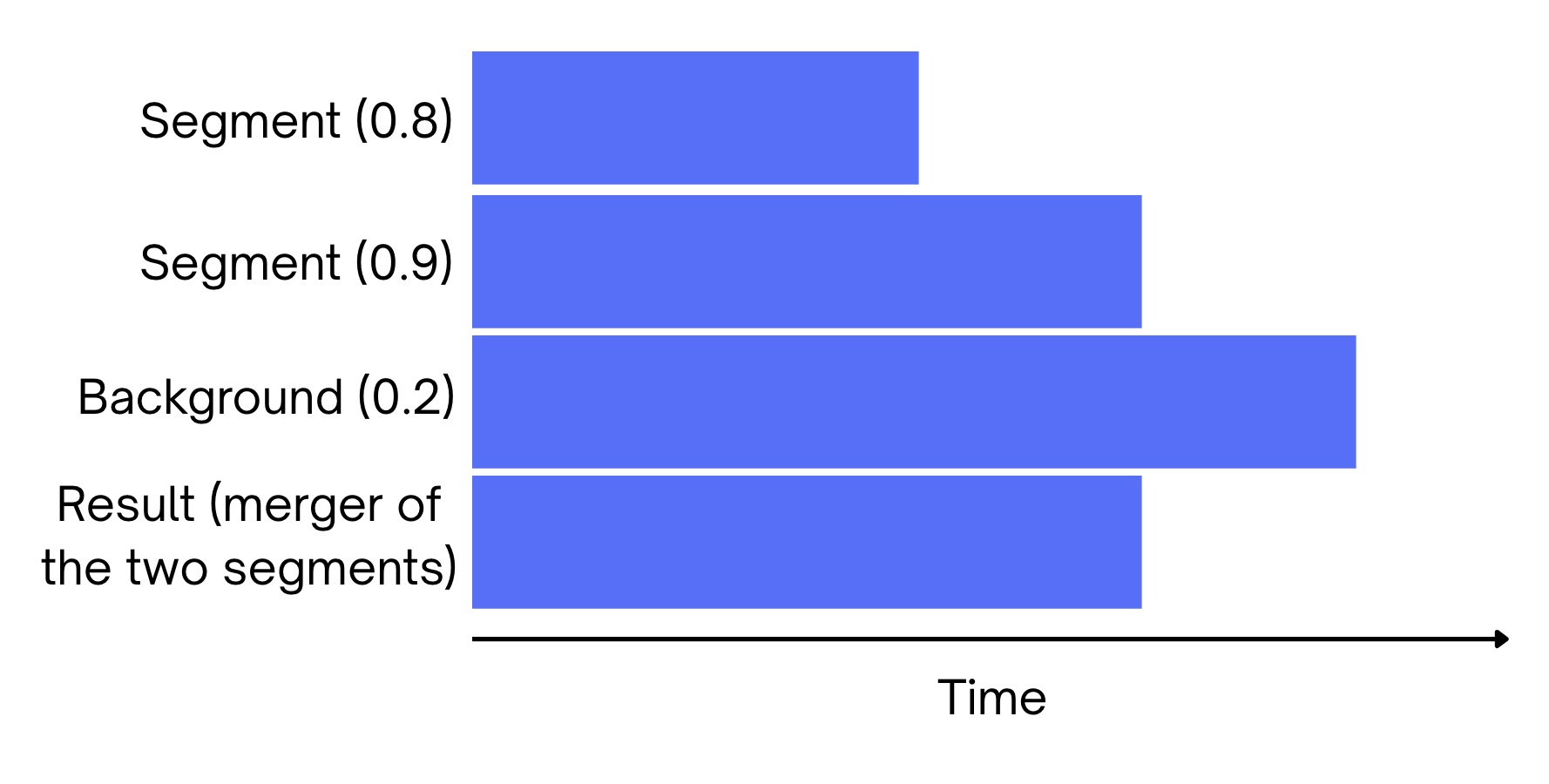
- Use of a sliding window (default 10s with 5s overlap).
- Prediction of the label for each window.
- Merging of consecutive windows having the same label to produce coherent segments.
Parameter Adaptation
To try to correctly detect the chronicles, the values of the following parameters were modified:
- Confidence Threshold: The confidence threshold above which a result is taken into account.
- Minimum Duration: If the model fragments a chronicle into several small pieces whose duration is less than the minimum duration without being merged, they are all deleted.
- Merge Logic (Gap Filling): Logic consisting of filling holes of less than 3-5 seconds between two detected chronicles (otherwise, if two segments of the same chronicle are separated by a short segment of “background” (noise, jingle), they are not merged).
Even when adjusting these various parameters, no satisfactory results were obtained during inference.
Dataset Balancing
One of the issues causing chronicles to not be detected correctly is the imbalance in the dataset: there are many more “chronicles” than “background” in a radio broadcast, which creates false positives.
The most precise method is the percentage lever. The script generates the data and then performs an automatic downsampling to reach the exact requested ratio.
- Principle: If 80% is requested, the script will calculate how many segments of each class to keep so that the background represents exactly 80% of the total.
Binary Detection (chronicle or not)
To simplify and improve chronicle detection, we ask the model to detect only the periods where there are chronicles (without naming them).
After applying all these techniques, we obtain a score of 38.09, which is also not sufficient.
Robust Prediction
1. Initial Problem
The original inference script took independent decisions per time window. If a single window in the middle of a chronicle got a confidence score slightly below the threshold, the chronicle was cut in two or ignored.
2. Technical Improvements
A. Smoothing by Competitive Score (Soft Voting)
Instead of simply taking the probability of the “chronicle” class, the script calculates a weighted score:
- If
prob_chronique > prob_background, the score is equal toprob_chronique. - If
prob_background >= prob_chronique, the chronicle score is divided by two.
This forces the score to drop drastically as soon as the model begins to lean towards background noise, creating clear separations between two chronicles.
B. Hysteresis Thresholding (Double Threshold)
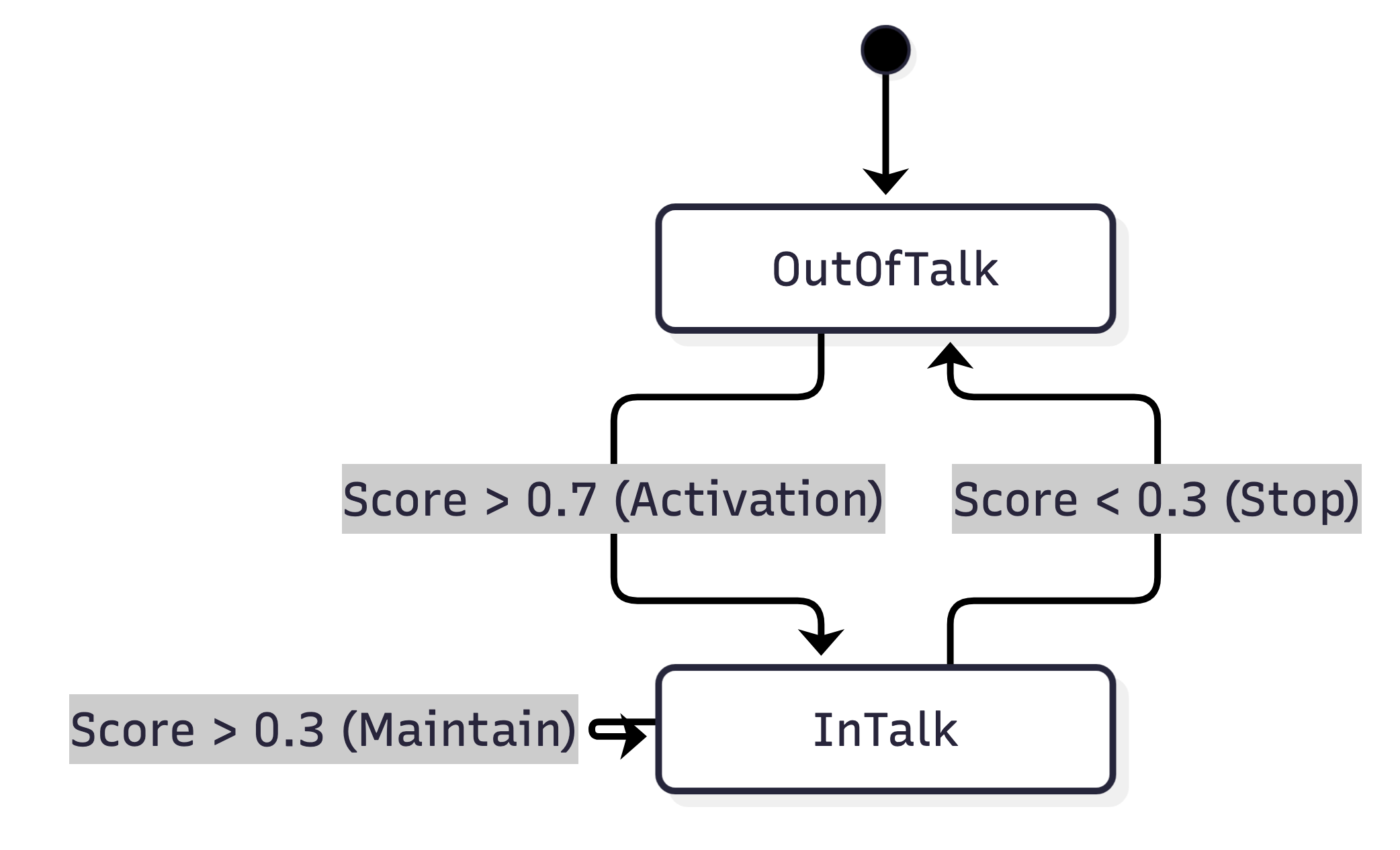
Using a single threshold creates oscillations. We now use two thresholds:
- Activation Threshold (
threshold_start): A high score (0.7) is required to trigger the start of a chronicle. - Hold Threshold (
threshold_end): A lower score (0.3) is sufficient to continue detection.
Unfortunately, the final score of the model is 8.6/100, or insufficient.
Smooth Prediction
This simplified version focuses solely on temporal smoothing via a moving average to stabilize detections without using the complexity of hysteresis or competitive scoring.
Principle of Smoothing (Moving Average)
In classic prediction, each window is treated independently. If the model has a micro-hesitation, the chronicle is cut.
The smooth approach works like this:
- It retrieves the probability of the chronicle class for each window.
- It applies a moving average to these probabilities (instead of looking at the probability of an isolated audio window to decide if it’s a chronicle, we look at the average of that window and the surrounding windows).
- A decision is made on the smoothed value relative to a single threshold.
The score obtained by this method is 0.0/100.
Hybrid Approach: Detection by Jingles
This approach aims to solve precision problems at the start of a chronicle by using introductory jingles as high-confidence anchor points.
Concept
Rather than trying to classify each 10-second segment as “chronicle” or “background” with a single model, which often creates ambiguities at the boundaries, the hybrid approach divides the problem into two steps:
- Jingle Detection: Search for the short and specific sound motif that announces the start of a chronicle.
- Chronicle Extension: Once the start is “anchored” by a jingle, use the general chronicle model to follow the speech until its natural end.
Jingle Model Training
The training script creates a binary model (Jingle vs. Background) optimized for acoustic signatures.
Sampling Logic
- Jingle class (Positives): The script extracts only the first 5 seconds of each chronicle defined in the timecodes. This is where the musical or sound signature of the broadcast is generally located.
- Background class (Negatives):
- Segments of silence or music between chronicles.
- Segments taken from the middle of chronicles (after the jingle). This teaches the model to distinguish between “the chronicle’s jingle” and “the chronicle’s speech”.
Model Used
Uses AST (Audio Spectrogram Transformer) (MIT/ast-finetuned-audioset), because its ability to analyze audio as an image (via spectrograms) is superior for recognizing repetitive musical patterns like jingles.
Hybrid Inference
This script combines both models for precise segmentation.
Algorithm
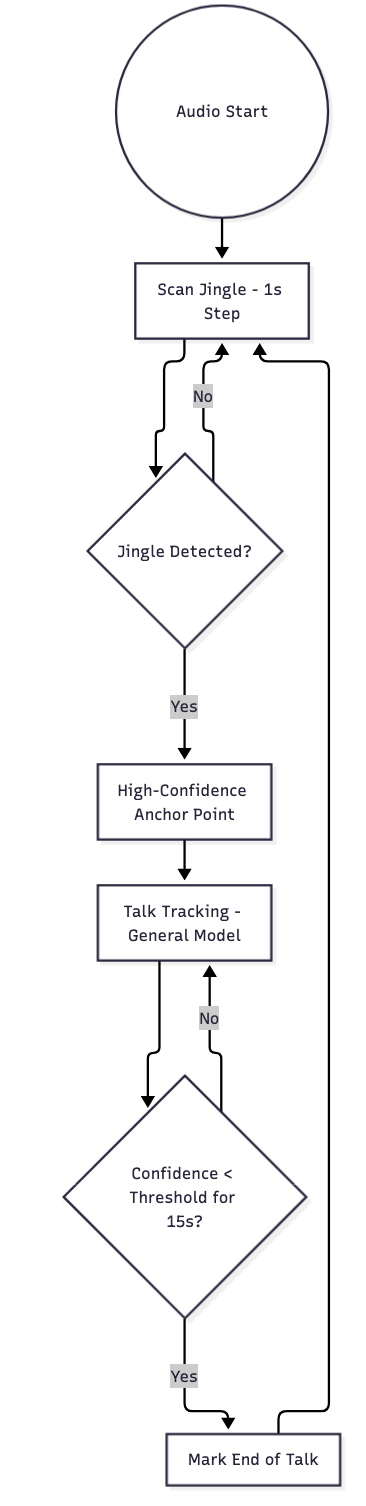
- Scan (1s step): The script scans the audio with the Jingle model. Since the step is short (1s), surgical precision is obtained for the start.
- Detection: If the Jingle probability exceeds the threshold (e.g., 0.8), an anchor point is created.
- Tracking: From this point, the script switches to the general Chronicle model. It advances in 5s jumps to check if the content is still a chronicle.
- Segment End: The end is marked as soon as the chronicle model returns low confidence for an extended duration (default 15s).
- Resumption: Jingle scanning resumes after the end of the detected chronicle.
The score obtained by this method is 0.0/100.
Fine-tuning Different Models
Although the facebook/wav2vec2-large-xlsr-53-french model is excellent for Automatic Speech Recognition (ASR), it has limitations for segment classification:
- Linguistic Bias: Wav2Vec2 is optimized to recognize phonemes and words. However, a chronicle is often detected by its sound texture (jingles, background music, acoustic quality), which Wav2Vec2 may tend to ignore.
- Heaviness vs. Task: The
largeversion (300M+ parameters) is heavy for simple binary or multi-class classification. This slows down inference and requires more data to avoid overfitting. - Local Analysis: Sequential processing of the raw wave may lack a “global” vision over a 10s segment, especially for identifying complex musical patterns (jingles).
Inferences
Chronicle timecodes (without naming them)
AST Model
Description: Converts audio into a spectrogram (image) and uses a Transformer (ViT) for analysis.
Advantages: Excellent for capturing acoustic signatures and jingles.
Model used: MIT/ast-finetuned-audioset-10-10-0.4593
Observations and Results
Model score: 2.9/100
BEATS Model
Description: One of the models for general sound classification.
Advantages: Trained to capture both speech and environmental/musical sounds. Very robust to noise and sound mixtures.
Model used: microsoft/beats-base
Observations and Results
Model score: 2.9/100
Given that the inference function has several parameters, we use a program that takes an audio and the actual location of chronicles in that audio and tests all combinations of parameter values to obtain this result, in order to know the optimal parameter configuration.
Unfortunately, no model has managed to obtain a result with the actual chronicle locations.
Chronicle Detection from Transcription and Audio of Radio Broadcasts
Using Multiple Approaches
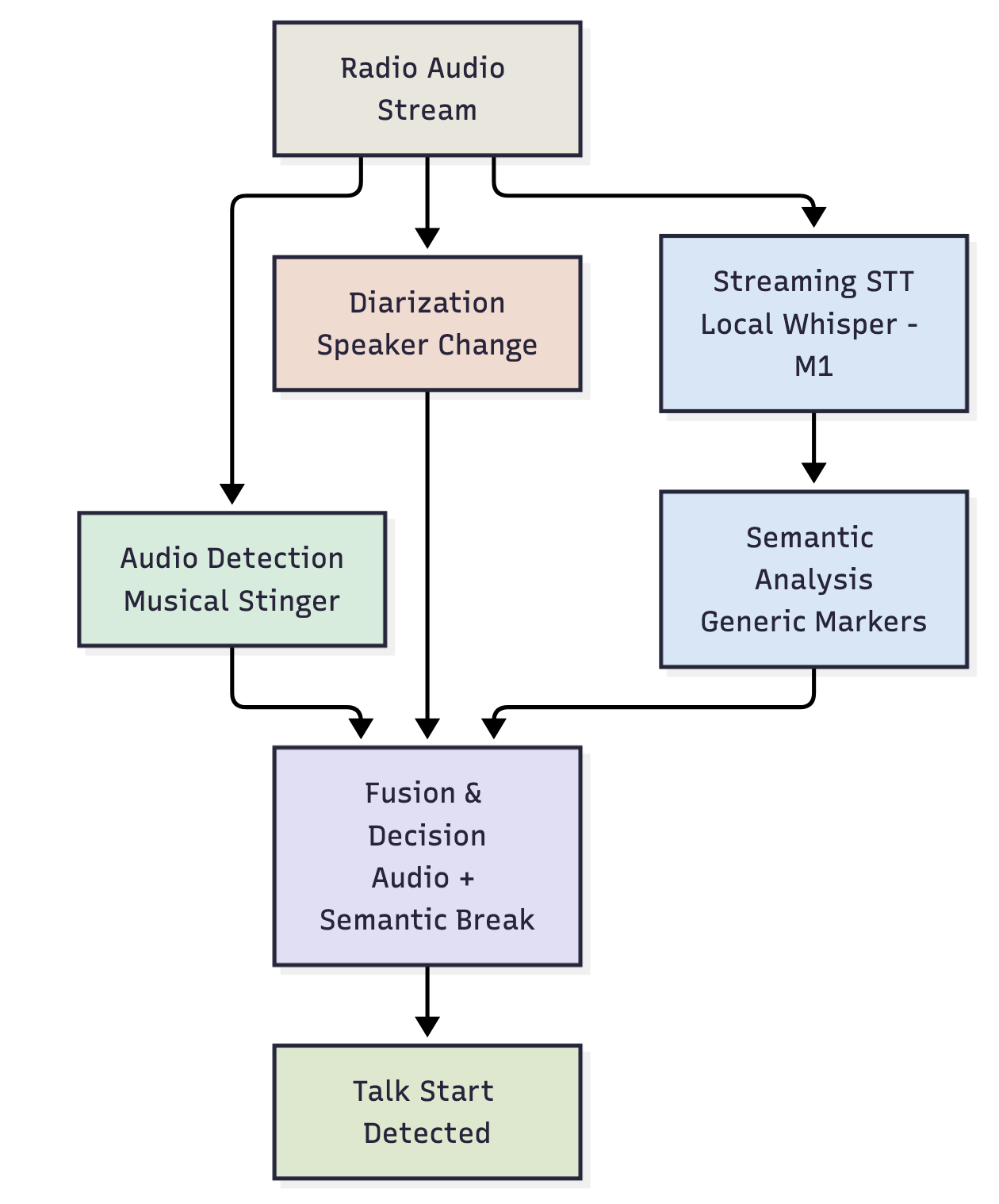
A “multi-modal” approach is used to detect the start of radio chronicles in real-time. Instead of relying on a single criterion, it merges several types of analyses to make a more robust decision.
Here are the main steps of the method:
1. Capture and Preprocessing
The system retrieves the audio stream (either from a file or a live stream like France Inter) and cuts it into small segments (chunks) to analyze them on the fly.
2. The “Fast Path” (Acoustic Fingerprinting)
Before launching heavy computations, the system checks if the audio segment resembles a known jingle.
- It generates a digital fingerprint of the sound.
- If there is a match in its database (e.g., the specific jingle of a show), it triggers the detection immediately.
3. Parallel Sensors (Multi-Approach)
If it’s not a known jingle, it activates 4 different sensors:
- Acoustic (Novelty): It detects abrupt changes in the sound texture (break in rhythm, change in atmosphere).
- Audio Events: It searches for the presence of music (often used for transitions) vs. speech.
- Diarization: It detects if the speaker changes (transition from presenter to chronicler).
- Semantic (LLM): The system transcribes the audio into text via Whisper (STT) and sends the text to a language model (like Llama 3) via Ollama. The AI analyzes if the words used resemble a chronicle introduction (e.g., “Hello everyone, today we’re going to talk about…”).
4. Score Fusion
Each sensor gives a score. The system makes a weighted average:
- Semantics (AI) has the most weight (40%).
- The other criteria (acoustic, music, speaker) share the rest (20% each).
5. Learning (Feedback Loop)
As soon as a chronicle is detected with certainty, the system records the sound fingerprint of that moment. If it was a jingle, it will recognize it even faster next time thanks to the Fast Path.